Why Can't Americans Live Without Ladders Made in Yongkang, China?
Has anyone ever wondered why Americans, when they need to fix a roof or trim trees in their garden, are using ladders made in China—specifically from a small county-level city in Zhejiang, Yongkang? Does America not manufacture ladders anymore?
A friend who works in cross-border e-commerce told me that while passing by Home Depot, the largest home improvement retail chain in the U.S., he found that the best-selling, neatly displayed aluminum multi-purpose ladders were all made in Yongkang, Zhejiang.
In the niche field of elevated work equipment, people from Yongkang have achieved global dominance. Currently, 90% of the aluminum ladders sold in Costco and Home Depot come from Yongkang, Zhejiang.
So, what is the reason behind this?
In fact, things were not like this twenty years ago. At that time, the ladder industry had "classes." The high-end market was firmly held by American brands like Werner and some century-old European brands. Because ladders are related to human life, the U.S. formulated extremely strict ANSI standards, and Europe had EN131 standards. They not only set technical barriers but also built walls in terms of brand and distribution channels. At that time, although Yongkang also manufactured ladders, they were mostly rudimentary wooden ladders or bulky iron ladders. They couldn't even get a booth at international exhibitions, let alone sell them to demanding Americans.
Today, I want to talk about how Yongkang, the "Capital of Hardware," turned a seemingly simple ladder into a billion-dollar industry. How did it rise? And what problems still exist? I hope to share this with you objectively and comprehensively.
Why are Americans inseparable from ladders?
Unlike us living in apartments, most Americans live in Houses in the suburbs. If the roof leaks, they fix it themselves; if leaves clog the gutter, they clear it themselves; if branches grow crooked, they prune them themselves. In the U.S., hiring labor is very expensive, so the "DIY culture" is a necessity. And the ladder is the first big-ticket item in the American family's toolroom.
But early ladders were very difficult to use. They were either wooden, which were heavy, prone to rot, and infested with insects, or they were ordinary iron ones that would rust quickly when placed outdoors.
People from Yongkang keenly discovered this opportunity and began to focus on aluminum profiles.
Many people think, how difficult can aluminum be? But on a ladder, it is really a science. You have to ensure the ladder is light enough for an American housewife to carry with one hand; at the same time, you have to ensure it is strong enough that a 200-pound giant can step on it without the ladder shaking at all.
Enterprises in Yongkang improved the aluminum formula and developed aviation-grade extruded profiles. This material has nearly doubled the compressive strength compared to ordinary aluminum under the same weight. This is the "hardcore" confidence of Yongkang ladders.
With good materials, people from Yongkang also invented a "Chinese-style folding."
As you know, shipping costs are one of the biggest costs in foreign trade. If a 5-meter straight ladder is transported horizontally, you can't fit many in a container, and the shipping cost would be higher than the value of the goods. Engineers in Yongkang designed multi-functional folding ladders and telescopic ladders. When shrunk, this kind of ladder is like an oversized suitcase, which can be easily stuffed into the trunk of a private car.
This design not only saves space for consumers but also saves shipping costs for enterprises. In the same container, Yongkang people can pack twice as much cargo as foreign competitors. This cost advantage directly cornered European and American local brands.
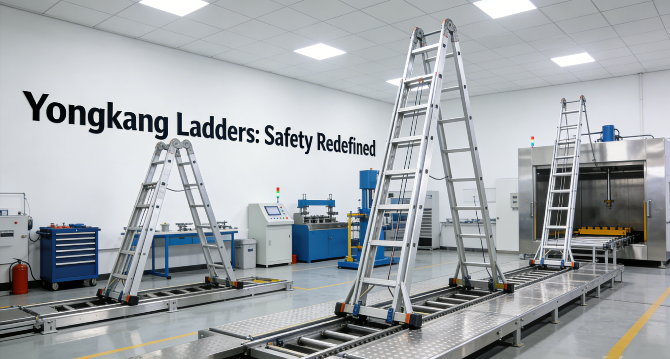
Nowadays, Yongkang is no longer the place of small workshops that only know how to imitate. Here lies the world's most advanced ladder testing center. Their developed ladders have to undergo tens of thousands of fatigue stepping tests and be placed in salt spray chambers to simulate extreme corrosive environments. People from Yongkang have turned "safety," a discourse power once monopolized by foreigners, into their core competitiveness.
Here, I want to specially mention the city of Yongkang.
Yongkang belongs to Jinhua and is located in central Zhejiang. Since ancient times, this place has enjoyed the reputation of "Hometown of Hundreds of Crafts." From aluminum profile extrusion, plastic injection parts processing, anti-slip pad molds, to the final rivet and instruction manual, everything can be supported within Yongkang's industrial chain. Besides ladders, what else does Yongkang have? It has the world's largest door industry base; one out of every three security doors in the country is made in Yongkang; it also has the largest power tool base in the country.
So, it is not that America cannot make ladders now, it is just not cost-effective. Yongkang has already pushed cost and efficiency to the limit of humanity. Even with freight and tariffs, it is still much cheaper than America making it themselves.
Many people may ask, with rising labor costs now, can Yongkang maintain this advantage?
In fact, bosses in Yongkang started changing a long time ago. Previously, it relied on manpower; now, it relies on machine replacement. In ladder factories in Yongkang, you will see robotic arms welding at high speed and automated assembly lines making precise riveting. They are upgrading the business of making ladders from traditional manufacturing to advanced manufacturing. In the future, when AI robots and higher-tech materials enter this industry, I believe the leaders will still be these Yongkang people who understand hardware and the market the best.
Of course, after telling so many inspiring stories, we cannot only look at the highlights and must also see the problems. Looking deeply into Yongkang's ladder industry, you will find that bosses also have their own hard times.
The most headache-inducing issue is the extremely fierce price war. Yongkang's industrial chain support is too perfect. If you want to open a ladder factory, even if you don't have machines, as long as you can get orders, you can find someone to open molds by turning left and someone to extrude aluminum profiles by turning right, and immediately assemble a ladder. Low barriers lead directly to internal competition. Everyone is fighting for meat in the same pool, and profits are squeezed to the bone to win orders from large overseas clients. A ladder sold to the U.S. may have a factory price of only a few dozen RMB, and the product added value and most of the profits are actually taken by foreign distributors.
This is actually a problem for many Chinese industries. It is very competitive, which is good for overseas competition because if it is this competitive domestically, who overseas can compete? But precisely because it is too competitive, locals can only drink soup and cannot eat meat.
Although many Yongkang enterprises have started cross-border e-commerce to build their own brands, the brand's moat is not easy to build. Foreign consumers instinctively trust these local big-box stores like Costco or Home Depot. Selling on e-commerce platforms, traffic costs are getting higher and higher, and algorithms and rules change every three days. Once meet exchange rate fluctuations, or skyrocketing shipping costs like in recent years, many small and medium-sized factories are really working for free for shipping companies and platforms.
Therefore, even if the product is made well, if you do not get real pricing power, you can only forever do hard labor at the bottom of the smile curve.
Why can't the price be increased?
Because making aluminum ladders is, after all, an industry that competes on raw materials. The price of aluminum ingots fluctuates greatly on the international market. When raw material prices rise, factories dare not casually raise prices for customers for fear that once the price goes up, customers will run to the factory in the next village, and most of the time they can only grit their teeth and bear the loss. Coupled with the current complex international trade environment, tariff barriers can be erected at any time.
This situation of high dependence on a single European and American market is still fragile in terms of risk resistance. How to truly transition from simply competing on production capacity and price to competing on core technological barriers and global brand influence is a major hurdle that these hardware giants in Yongkang are currently going through.
Any industry will inevitably encounter various problems during its development and will spiral upward amidst challenges and difficulties. This is the path of China's industrial rise.
This is Darren Qin From Seenwills, telling the story of China's industrial rise and helping more ordinary people understand China's various industrial clusters to find their own opportunities.
In-depth Analysis: Ladder Industry Classification, Trends, and Buying Guide
1. Ladder Classification Methods and Examples
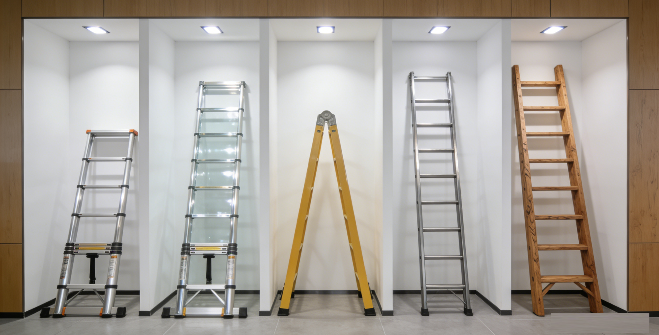
Ladder classification is usually based on three core dimensions: structure, material, and function.
-
By Structure:
- Leaning Ladder: Needs to lean on a wall or other support, such as common telescopic ladders and straight ladders.
- Self-supporting Ladder: Stable in itself without external support, such as step ladders (A-frame ladders).
- Combination Ladder: Can change shape to achieve multiple forms, such as being both a straight ladder and a step ladder, or even being split into a work platform.
- Special Ladders: Including mobile ladders (with wheels) and insulated ladders (for electrical work).
-
By Material:
- Aluminum Alloy Ladder: The current mainstream for home and commercial use, light, corrosion-resistant, and high strength.
- Fiberglass Ladder: Has excellent insulation, the first choice for risky-work like power and telecommunications.
- Steel/Iron Ladder: Strong load-bearing capacity but heavy and prone to rust, mostly used in specific industrial scenarios.
- Wooden Ladder: Traditional material, good texture but difficult to maintain, gradually replaced by aluminum alloy.
-
By Function and Scene:
- Household Ladder: Focuses on storage, convenience, and safety, such as folding ladders and small-step ladders for small homes.
- Engineering Ladder: Emphasizes durability and stability, such as thickened aluminum alloy telescopic ladders.
- Special Ladder: Fire ladders, insulated ladders, etc.
2. Global Ladder Market Trends and Capacity Analysis
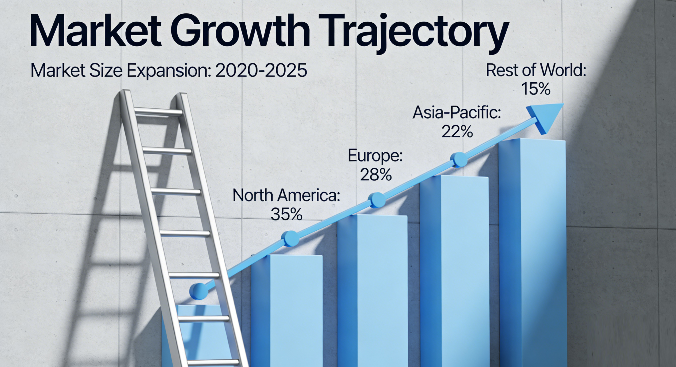
The global ladder market capacity is stably in the hundreds of billions of dollars. North America and Europe, due to their mature DIY culture and strict industrial safety regulations, remain the largest consumer markets. The Asia-Pacific region is growing rapidly along with urbanization.
- Market Trends:
- Lightweight and High Strength: The application of new materials like aviation-grade aluminum alloy and carbon fiber is the focus of competition.
- Multi-functionality and Convenience: "One ladder, multiple uses" and "quick storage" have become standards, especially for telescopic and transformable ladders.
- Intelligentization: The high-end market has begun to see intelligent ladders integrated with levels, LED lighting, and even IoT monitoring (like tilt alarms).
- Globalization of Safety Standards: Products conforming to ANSI (American standard) and EN131 (European standard) have become compulsory courses for export enterprises.
- Industry Landscape: China (especially Yongkang, Zhejiang) dominates the manufacturing of low-end and some mid-to-high-end products, while American Werner and German AluDübel brands still occupy the brand high ground of the high-end professional market.
3. What Details to Pay Attention to When Buying a Ladder
Choosing a ladder cannot be based solely on price; safety is the first lifeline.
- Identify Safety Standards: Before buying, be sure to confirm whether the product meets the safety standards of the country or region (such as China's GB/T 17889 series standards). Regular products will have clear load-bearing marks and certification marks.
- Check Material and Craftsmanship: Give priority to aviation aluminum alloy. Check the wall thickness of the tube (usually the thicker, the more stable; it is recommended to be above 1.5mm for home use), the welding points should be smooth without cracks and burrs.
- Check the Locking Mechanism: This is the soul of the ladder. The buckles of the telescopic ladder must be crisp and firm, and there should be minimal shaking after unfolding; the hinges of the step ladder should be flexible and reliably locked.
- Pay Attention to Anti-slip Design: The feet of the ladder must have wide rubber anti-slip pads, and it is best if they are replaceable. The surface of the pedal should have anti-slip patterns or anti-slip pads.
- Measure the Usage Scenario: Don't buy one that is too high or too low. Generally speaking, the top of the ladder must be at least 1 meter higher than the support point. It is recommended to choose a step ladder for indoor use and a telescopic ladder for outdoor work.
4. Other Ladder Industry Clusters?
Although Yongkang in Zhejiang is the undisputed "World Capital of Hardware" and the core of ladder manufacturing, there are several other important industrial agglomeration areas in China, forming a pattern of differentiated competition:
- Hangzhou, Zhejiang (Xiaoshan/Fuyang): This is also an important base for ladder exports, home to a batch of large enterprises deeply engaged in foreign trade, with products mostly directly exported to Europe and America.
- Handan, Hebei (Yongnian District): Although Yongnian is more famous for "fasteners (screws and nuts)" and is known as the "Capital of Fasteners in China," its strong metal processing support provides a solid foundation for the surrounding ladder and scaffold manufacturing. The industry here is more biased towards steel building accessories and heavy-duty ladders.
- Foshan/Zhongshan, Guangdong: The Pearl River Delta region is developed in home appliances and metal processing, which has also given rise to a number of enterprises focusing on high-end home ladders and stainless steel ladders, with high design sense and craftsmanship.
These industrial belts together constitute the powerful map of China's ladder manufacturing industry, sending "Made in China" ladders to every corner of the world.
What else Yongkang City can produces? Please read it here: