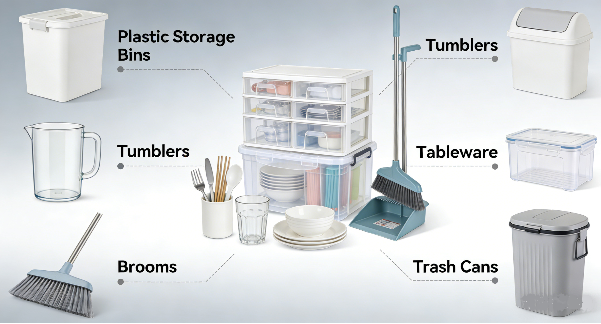
Are you looking to source large quantities of plastic storage bins, tumblers, tableware, brooms, or trash cans?
Today, SEENWILLS brings you an in-depth look at one of China’s most outstanding industrial powerhouses. We’ve curated this guide to help global buyers navigate the ecosystem of Taizhou, covering everything from industry insights to logistics.
- Main products made in Taizhou Zhejiang
- Taizhou Plastic Homeware Products
- How to Choose Taizhou Best Plastic Items
- Looking for Advanced Plastic Product Suppliers in Taizhou
- Packing Solution on Plastical Housewares
- Shipping Advices on Plastic Consumer Products
- Trends of Taizhou Plastic Items
- Purchasing Experience in Taizhou Manufacturers
- Transportations to Taizhou City
* If you want to know Taizhou better you can contact seenwills to get the great consultant.
- A Glimpse at Taizhou’s Core Industries: From the "Plastic Kingdom" to a "Smart Manufacturing Hub"
Taizhou, often hailed as a "City of Manufacturing," has an industrial footprint that extends far beyond plastic goods. As a major manufacturing hub in the Yangtze River Delta, it is building a modern industrial system centered on the "5+5+6" strategy.
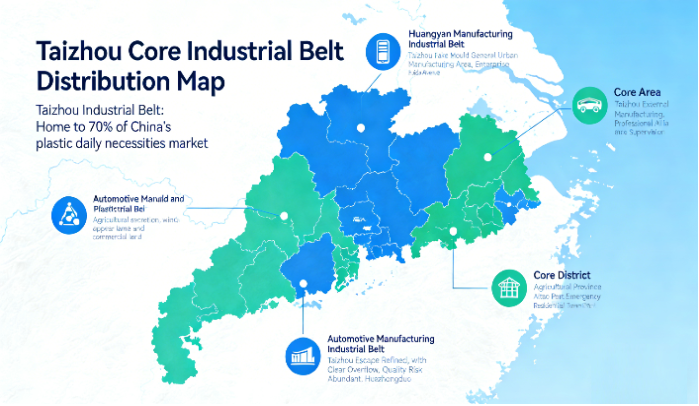
In traditional sectors, Taizhou boasts two national advanced manufacturing clusters. The automotive and components industry is a pillar, home to giants like Geely and Volvo, forming a complete ecosystem. However, the crown jewel remains the mold and plastic industry. Huangyan is known as the "Hometown of Chinese Molds," supporting approximately 70% of the nation’s plastic daily necessities market share.
In emerging section, Taizhou is sprinting ahead with new energy vehicles, high-end equipment (industrial machine tools), and green energy. Looking toward the future, Taizhou is cultivating clusters in low-altitude economy (aerospace), embodied intelligence (robots), and synthetic biology, exemplified by Geely’s aerospace satellite projects.
- Decoding the Industrial Belt: A Deep Dive into Taizhou’s Plastic Products Industry
Stepping into Taizhou is like entering the heart of China’s plastic home products industry. With over 13,000 plastic product manufacturers and an annual output value exceeding 60 billion RMB, it is a dominant force.
Currently, the industry is undergoing a profound transformation. Moving away from reliance on scale and cost, Taizhou is pivoting toward "branding, digitalization, and intelligence." The 2025 launch of the "Taizhou Plastics" regional public brand is a landmark event, aiming to solve industry overcompetition.
Especially in design and R&D, Taizhou has introduced AI-assisted industrial design and 3D printed molds, drastically shortening product design cycles. Through C2M (Customer-to-Manufacturer) flexible manufacturing, a new storage box concept can be turned into a commodity rapidly.
- The Professional’s Guide: How to Pick High-Quality Plastic Daily Necessities
In a sea of plastic products, how do you develop a "discerning eye" for quality? Focus on these core dimensions:
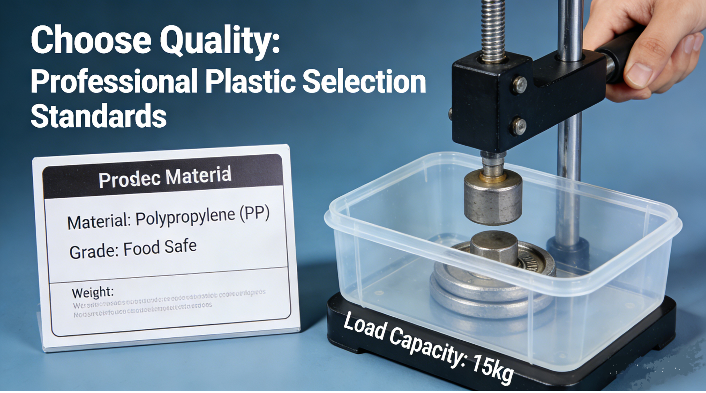
First, check the material identification. Food-grade plastics are usually PP (Polypropylene) or Tritan, marked with a triangular recycling symbol. PP is heat-resistant, ideal for lunch boxes, while Tritan is clear and shatterproof, perfect for water cups.
Second, inspect the craftsmanship. High-quality products have smooth surfaces without burrs, uniform wall thickness, and smooth opening/closing mechanisms. For storage items, load-bearing capacity is key.
Finally, never overlook eco-friendliness. Avoid products with pungent odors, which often indicate inferior recycled materials. From both environmental and health perspectives, sourcing products with eco-certifications is wise. Although the initial procurement cost may be slightly higher, their long service life and low breakage rate lower operational costs in the long run.
- Sourcing Strategies: How to Find Premium Suppliers in Taizhou
Finding direct factories in Taizhou is key to controlling costs and ensuring supply stability. Here are four efficient channel strategies:
Direct factory sourcing offers the highest profit margins. Contacting manufacturers in Huangyan or Tiantai directly can lower purchase prices by over 30% compared to secondary wholesalers. We recommend starting with small trial orders.
E-commerce platforms are suitable for light-asset operations. On 1688, many Taizhou enterprises participate in "Yanxuan" or "Industry Belt" channels, supporting drop-shipping and effectively solving inventory pressure.
Regional distribution centers are also an option. Although Yiwu is a comprehensive small commodities hub, a large portion of its plastic products originate from Taizhou, suitable for small-batch, multi-variety procurement.
Lastly, brand franchising and supply chains. If you are a chain store or community group leader, connecting to a brand’s supply chain system can provide intelligent product selection support and lower the risk of unsold inventory.
- Safety First: Packaging & Protection Solutions for Long-Distance Transport
Although plastic products are lightweight, they are prone to damage from compression, friction, or environmental factors during long transport. Scientific packaging is the first line of defense.
For scratch-prone glossy products, use bubble wrap or pearl cotton for internal fixation and partitions to prevent collision. For the high-humidity marine environment, sufficient desiccants must be placed inside the packaging, using reinforced corrugated cartons.
For large plastic furniture or equipment, wooden pallets with strapping are recommended, along with a "Center of Gravity" label to prevent tipping during loading/unloading. Professional logistics service providers usually offer customized packaging solutions, which is key to reducing cargo damage rates.
- Going Global: Efficient International Logistics Channels for Plastic Goods
Choosing the right logistics channel directly impacts capital turnover and customer experience. The main international transport methods include express, air, sea, and multimodal transport.
For high-value or urgent samples, international express (DHL, FedEx) is the first choice, offering speed at a high cost. For bulk, low-value goods, sea freight is the most cost-effective. For instance, shipping from Ningbo or Guangzhou ports to Africa or South America can greatly reduce unit costs, though it takes longer (approx. 30-40 days).
Specially, dedicated logistics lines for specific markets (like the Middle East) are emerging. These lines integrate air and land transport, offering "Double Clearance and Tax Included" services, effectively solving customs difficulties.
- Trend Insight: The New Horizon of International Trade in Plastic Daily Necessities
Global plastic trade is facing structural changes. In 2024, China’s plastic product exports exceeded 90 billion USD, accounting for 35% of the global share. However, new challenges and opportunities arise.
On one hand, pricing models are iterating. The past reliance on "one-order-one-negotiation" is shifting toward futures pricing. Utilizing futures tools for hedging is becoming a must for foreign trade enterprises.
On the other hand, green trade barriers are becoming more prominent. Developped markets demand stricter environmental standards; products made from recycled materials (like PP, PET) are more popular. Additionally, localized design for different markets is a trend—bold colors for developped countries, and durability for African markets.
- Field Experience: Procurement Insights from a Veteran Buyer
As a procurement veteran, I’d like to share some "pit avoidance" tips.
First, don’t just look at price. Low prices often mean material downgrades or wall thickness reductions, leading to high after-sales return rates. Assess the "full lifecycle cost."
Second, emphasize the sampling phase. Conduct strict sample tests (drop tests, load tests, odor tests) before mass production.
Third, focus on supply chain flexibility. Choose suppliers who support small-batch, multi-batch production to stay agile.
Lastly, long-term cooperation is more important than a single transaction. Establishing trust with factories ensures you get priority production resources during peak seasons.
- Visiting the Source: Travel & Transportation Advice for Visiting Taizhou
If you plan to visit Taizhou to inspect factories, this travel guide will help. Taizhou has convenient transportation, including high-speed rail and an extensive rail transit network.
High-speed Rail: Taizhou Station (in Jiaojiang) and Taizhou West Station (in Huangyan) are the main hubs. Since Huangyan is the core of the mold and plastic industry, getting off at Taizhou West Station may be more convenient.
Public Transit: Taizhou has a modern transportation equipments S1 line connecting Jiaojiang, Luqiao, and Wenling. For inter-county factory inspections, we recommend ride-hailing or renting a car, as factories are widely distributed, making Auto Drving more flexible and efficient.
Note on Pricing Tiers: In actual procurement, Taizhou’s plastic products are generally mid-priced, suitable for the mid-tier market. If you need high-end materials and brand-level mass production, Guangdong Province is usually the target. If you specifically need very low-cost plastic goods, the main production areas are in Hebei and Shandong.
Contact the SEENWILLS SUPPLY CONSULTANT TEAM for more assistance if you are in such plastical item business.