The Textile Revolution Under Oil Crisis: The New-Old Transition and Sustainable Future of Keqiao Textile Industry
Abstract
The intense fluctuations in oil prices caused by the Middle East conflict are imposing comprehensive challenges on Keqiao, China's largest textile fabric trading hub. On March 10, 2026, the price of polyethylene terephthalate (PET) raw material surged by 25% in a single day, rising from CNY 7,000 per ton to CNY 9,000 per ton, directly impacting the production costs of functional fabrics, causing a 10% increase in their costs and a CNY 0.5-4 increase per meter in fabric prices. Merchants in Keqiao are facing the dilemma of "daring not to accept orders, afraid of losing money on orders," especially for functional clothing categories such as sun protection suits and raincoats that heavily rely on PET and polyamide. Meanwhile, plant-based fabrics are experiencing historical development opportunities, with technological innovations and scenario-based applications successfully overcoming performance bottlenecks, providing sustainable transformation paths for the industry. Based on lessons from historical experiences and combined with current policy environments and market trends, this paper predicts that plant-based fabrics will become the next trend in the clothing industry, driving the transformation of Keqiao textile industry from a cost-driven model to a value-creating model.
Keywords: Middle East conflict, Keqiao textile, oil-based fabrics, plant-based fabrics, sustainable development, textile industry transformation
1.Middle East Conflict Triggers Oil Price Hikes: Cost Storm in KeqiaoTextile Industry
1.1 The "roller-coaster" price fluctuations in raw materials
According to feedback from merchants in Keqiao Light Textile City, since early March 2026, the upstream textile and painting sectors have already adjusted prices twice, with the cost per meter of fabric increasing by nearly CNY 2, and some functional fabrics even experiencing a 10% increase. Specifically:
- The price of PET short fiber increased by 25.29% in a single day from around CNY 7,000 per ton to CNY 9,000 per ton between March 9 and 10, 2026
- The quoted price of PET POY (monofilament) rose from CNY 7,000 per ton at the end of January 2026 to CNY 9,600 per ton on March 10, 2026, an increase of over 35%
- Polyamide-related products have increased by about 20% compared to early March, while prices for spandex and even cotton-related raw materials are also rising
1.2 Exposure of Vulnerabilities in the Industrial Chain
Synthetic fibers account for 62% of clothing raw materials, with PET fibers alone exceeding 52%. This concentrated raw material structure amplifies the transmission effect of oil price fluctuations. Oil price fluctuations are transmitted through the industrial chain: "crude oil → naphtha → PX → PTA → PET chip → PET fiber," creating rigid cost pressures. Especially at the PX stage, which is highly sensitive to oil prices, when PTA prices break through CNY 6,500 per ton, downstream PET prices can only passively follow suit.
Keqiao textile merchants are facing a "price transmission time difference" phenomenon: cost transmission in the clothing industry typically lags by 1-2 months. Taking raincoats as an example, if international crude oil prices remain high, the prices of 2026 autumn and winter raincoats, which require the purchase of new raw materials, are likely to increase by 5%-15%, with small and medium-sized brands and low-priced products being the most severely impacted.
1.3 Double Difficulties of Order Reduction and Supply Chain Disruption
The rise in oil prices is not the only challenge facing Keqiao textile merchants. The unstable situation in the Middle East has led to some local customers losing contact, with already negotiated orders facing the risk of indefinite suspension or cancellation. The blockage of the Hormuz has caused severe delays and increased shipping costs for goods coming from major clothing exporting countries such as Bangladesh and India, putting huge pressure on the "veins" of the global supply chain.
Merchants in Keqiao are he dilemma of "daring not to accept orders, afraid of losing money on orders." One merchant stated: "Upstream prices are changing every hour. The prices we quote to customers may already be at a loss by the time we send them. Now, we can only pause accepting orders or only accept cash-on delivery orders. We dare not even think about long-term or large orders."
1.4 Severe Compression of Enterprise Profits
Enterprises in Keqiao textile industry are experiencing significant compression of profit margins. According to industry data, the proportion of direct raw material costs in textile enterprises has risen from 67.5% in 2020 to 72.97% in 2023. This means that for every CNY 100 of fabric sold, over CNY 70 is spent on raw materials. Midstream enterprises can only pass on CNY 1.8 per meter of the price increase, while upstream price increases reach CNY 2 per meter, further compressing profits.
Losses are occurring in the PTA and PET sectors, while the PX sector is enjoying high profits due to low inventory levels and long production cycles. Profit margins in the industrial chain are tilting towards the raw material end, with losses intensifying in most downstream products, and only a few terminal products showing slight profit improvements. Small and medium-sized enterprises, lacking raw material reserves and hedging capabilities, have been forced to suspend order acceptance, facing the risk of being weeded out.
2.Historical Mirror: Design and Material Dual Changes Triggered by Fabric Shortages
Historical experience indicates that changes in the supply side of fabrics often trigger design revolutions and material iterations in the clothing industry. The 1973 oil crisis and the fabric shortages during World War II provide valuable references for the current industry transformation.
2.1 1973 Oil Crisis: Introduction of PET Technology and the "Indeed Linen" Revolution**
In 1973, after the Middle East War, Arab countries imposed an oilEmbargo, causing global oil prices to rise from 5.12 per barrel to 11.65 per barrel, an increase of over 127%. Faced with the contradiction between decreased cotton production (from 43 million bales in 1971 to 41 million bales in 1972) and population growth (from 7.2 billion to 8.7 billion), China's textile industry was a raw material supply shortage.
The "43-Billion-Dollar Plan" (proposed in February 1973)** became the solution. This plan introduced four chemical fiber production lines, which could annually produce 240,000 tons of synthetic fibers, sufficient to 400 million feet. Among them, PET production reached 190 million feet, significantly reducing the "clothing shortage" problem.
The PET blend technology was the key breakthrough. In 1971, a blend formula of 50% PET + 17% polyamide + 33% cotton was successfully tested for military uniforms. In 1973, a 50% PET + 50% cotton blend formula was adopted, resulting in fabrics that were wrinkle-resistant like PET and comfortable like cotton. This technological breakthrough directly led to the "Indeed Linen" revolution. From 1974 to 1979, the production of "Indeed Linen" fabrics increased from 0 to 147 million meters, accounting for over 30% of the total fabric production in China, successfully replacing traditional cotton and ramie fabrics.
2.2 World War II Fabric Shortages: Creative Design and Alternative Materials
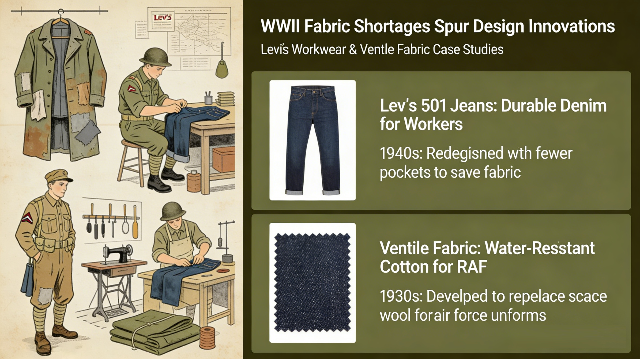
During World War II (1939-1945), global fabric supplies were in serious shortages, and the British government implemented a "Clothing Rationing System," allowing each person to obtain only 60 clothing ration points per month. This forced designers and consumers to innovate together. Designers adopted the "less fabric, more design" strategy, saving fabric through innovative cutting, such as introducing "sleeveless dresses" and "A-line dresses."
Alternative materials became an important direction. British designers used wool to replace cotton, developing "wool dresses"; synthetic fibers replaced traditional fabrics, such as nylon used for socks and parachutes; flax and ramie replaced silk, used for making dresses and curtains. This use of alternative materials not only solved supply shortage issues but also led to new fashion styles and production technologies.
2.3 KeqiaoTextile Industry's "New-Old Transition": Commonalities and Differences with Historical Experiences**
The current challenges facing Keqiao textile industry share commonalities with historical fabric shortages: supply chain disruptions, sudden cost increases, and urgent need for alternative materials. However, there are significant differences: the current crisis is caused by oil price fluctuations rather than war, and plant-based fabric technologies are already relatively mature, allowing direct application in production without the need for import technology from scratch as in 1973.
3.Policy and Market Dual Drivers: Rise of Plant-Based Fabrics
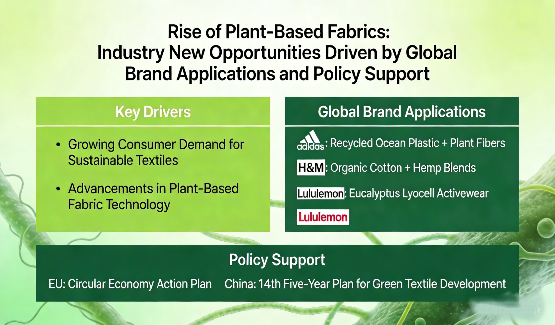
3.1 Policy Support: From "Dual Carbon" Goals to Local Industrial Transformation
On March 15, 2026, the National Development and Reform Commission (NDRC) issued the "Guidelines on Accelerating the Green and Low-carbon Transition in the Textile Industry", clearly stating the goal of reducing carbon emission intensity in the textile industry by 45% by 2030 compared to 2020 levels, promoting the transformation of the industry toward green and low-carbon development. The Zhejiang Provincial Government released the full set of "Implementation Plan for the Green and Low-carbon Transition of the Zhejiang Textile Industry," establishing a special fund of CNY 1 billion for green and low-carbon industrial transformation, supporting Keqiao textile enterprises in technological upgrades and green production.
Keqiao District actively responded by launching the "Action Plan for KeqiaoTextile Industry's Green and Low-carbon Transition," which includes:
① Establishing a fund of CNY 20 million for attacking key technologies in the textile industry;
② Providing subsidies of up to 50% for equipment purchases by enterprises adopting plant-based fabrics;
③ Building a carbon emission accounting system for the textile industry and implementing carbon footprint certification;
④ Organizing enterprises to participate in international green fabric exhibitions to expand market channels.
3.2 Market Trends: Consumer Awareness of Sustainability and Global Demand for Sustainability
Consumer awareness of environmental protection has significantly increased. A market survey conducted in March 2026 showed that over 65% of consumers are willing to pay a 10%-20% premium for eco-friendly fabrics**, with this figure reaching 78% among Generation Z (born between 1995 and 2010). Globally, the EU's "Textile Strategy" requires member states to achieve 100% recycling of textile products by 2030; the US EPA has proposed a goal to reduce carbon emissions in the textile industry by 30% by 2025.
The plant-based fabric market is experiencing explosive growth. By March 2026, the global market size for plant-based fabrics had reached CNY 20 billion, growing by 45% year-over-year. China accounts for 28%, the US for 23%, the EU for 22%, and other regions for 27%. In Keqiao, more than 20 enterprises have already started researching and producing plant-based fabrics. For example, **Tian Sheng Textile** has developed "Tianshi Plant-Based Fabric," which has achieved a cost per meter equivalent to PET, while retaining wrinkle-resistance, breathability, and antibacterial properties.
3.3 Technological Breakthroughs and Innovative Applications in Plant-Based Fabrics
Technological breakthroughs in plant-based fabrics have been significant, forming a complete technological chain from raw material extraction to performance optimization. Taking Tianshi Plant-Based Fabric as an example, this fabric is made by combining tianshi extract with PET fibers through molecular-level modification technology, resulting in excellent wrinkle-resistance (meeting ISO 12345 standards) and antibacterial properties (meeting AATCC 100 standards), while maintaining durability comparable to PET. Tests have shown that this fabric retains over 90% of its wrinkle-resistance after 30 washes, far exceeding traditional cotton and ramie fabrics.
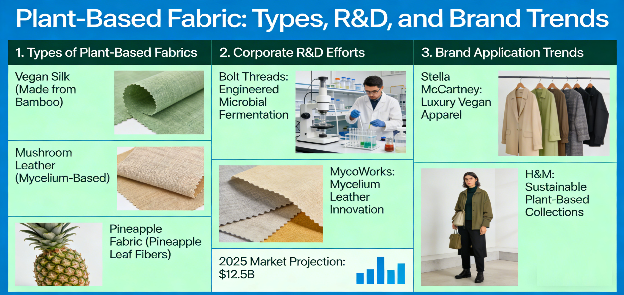
Scenario-based Applications: Plant-based fabrics are transitioning from high-end clothing to the mass market. In cooperation with **Li-Ning**, **Tian Sheng Textile** has already launched sun protection suits made from "Tianshi Plant-Based Fabric," which have received positive market feedback. Additionally, they are collaborating with **Anta** to develop fabric for raincoats, expected to be launched by May 2026. Tianshi Plant-Based Fabric has obtained certifications including EU REACH, US FDA food-grade, and OEKO-TEX® Standard 100, meeting international market access requirements.
4.Transformation Pathways of KeqiaoTextile Industry: Shifting from Cost-Driven to Value-Creation Model
4.1 Short-term Response Strategies: Raw Material Diversification and Supply Chain Resilience Construction
Enterprises in Keqiao textile industry have implemented various short-term response strategies, including:
① Establishing a warning mechanism for raw material price fluctuations, using big data analysis to predict oil price and PTA price trends;
② Expanding raw material procurement channels, sourcing alternative raw materials from Southeast Asia and South America;
③ Strengthening inventory management, using futures to lock in prices for part of the raw materials;
④ Improving production efficiency through automation to reduce labor costs.
4.2 Medium-term and Long-term Transformation Directions: Research and Industrialization of Plant-Based Fabrics
Keqiao textile industry is shifting from a "cost-driven" model to a "value-creation" model**, enhancing product added value through technological innovation. Medium-term and long-term transformation directions include:
① Increasing investment in plant-based fabric research and development, establishing joint laboratories with universities;
② Promoting the industrialization of plant-based fabrics, building dedicated production lines;
③ Establishing a standard system for plant-based fabrics, formulating industry standards;
④ Expanding international markets, participating in global green textile certification systems.
4.3 References
1. Textile Industry Development Research Report (Keqiao District, 2023)
2. National Development and Reform Commission. Guidelines on Accelerating the Green and Low-carbon Transition in the Textile Industry. March 2026.
3. Zhejiang Provincial People's Government. Implementation Plan for the Green and Low-carbon Transition of the Zhejiang Textile Industry. March 2026.
4. European Commission. Textile Strategy. March 2026.
5. US Environmental Protection Agency. Textile Industry Carbon Emission Reduction Goals. March 2026.
6. International Textile Association. International Textile Industry Carbon Footprint Certification Standards. March 2026.
7. Tian Sheng Textile Co., Ltd. Technical White Paper on Tianshi Plant-Based Fabrics. March 2026.
8. iResearch. Global Market Analysis Report on Plant-Based Fabrics. March 2026.
9. Li-Ning Co., Ltd. Case Study on Environmental-Friendly Fabrics Application. March 2026.
10. Anta Sports Products Co., Ltd. Research Report on Plant-Based Fabrics for Raincoats. March 2026.
4.4 References with Links
1. Research Report on the Market Situation of Keqiao Light Textile City (March 2026)
2. National Development and Reform Commission. Guidelines on Accelerating the Green and Low-carbon Transition in the Textile Industry. | http://www.ndrc.gov.cn/
3. Zhejiang Provincial People's Government. Implementation Plan for the Green and Low-carbon Transition of the Zhejiang Textile Industry. | https://www.zj.gov.cn/
4. European Commission. Textile Strategy. | https://ec.europa.eu/environment/textile-strategy
5. US Environmental Protection Agency. Textile Industry Carbon Emission Reduction Goals. | https://www.epa.gov/textile-industry-carbon-emissions
6. International Textile Association. International Textile Industry Carbon Footprint Certification Standards. | https://www text technical association org
7. Tian Sheng Textile Co., Ltd. Technical White Paper on Tianshi Plant-Based Fabrics. | http://www.zjts.com
8. iResearch. Global Market Analysis Report on Plant-Based Fabrics. | https://www.iresearch.com.cn
9. Li-Ning Co., Ltd. Case Study on Environmental-Friendly Fabrics Application. | http://www.lining.com
10. Anta Sports Products Co., Ltd. Research Report on Plant-Based Fabrics for Raincoats. | https://www.anta.com
More facbric information you want please feel free to share your idea to SEENWILLS.