Are you willing to make your own brand socks or purchase socks in bulk?
Here are some contents for your sock business guides:
1. Socks Industry in Zhuji;
2. Status of Zhuji Socks Now;
3. Opportunities And Challenges for Socks Business;
4. How to Choose Quality Socks;
5. How to Select a Reliable Sock Suppliers in China;
6. Business Guides on Purchasing Socks in Zhuji;
7. How to Get to Zhuji Easily;
If you want to know more informations about Zhuji, please ask seenwills sales.
- Why Did the Hosiery Industry Emerge in Zhuji?
The rise of the hosiery industry in Zhuji (specifically centered in Daxi/Datang District) is the result of serendipitous opportunities, geographical advantages, market dynamics, and strategic policy guidance.
- Serendipitous Opportunity & Grassroots Entrepreneurship: In the late 1970s, a local production team in Chengshan (now part of Daxi) accidentally purchased three second-hand manual knitting machines. The high profitability compared to traditional agriculture sparked a wave of grassroots entrepreneurship. The "shop-front, factory-back" household workshop model emerged rapidly, laying the industrial DNA.
- Geographical & Locational Advantages: Located merely 52 kilometers from Yiwu, Daxi leveraged the radiation effect of the Yiwu Commodity Market. This established the early collaboration model of "Daxi Production, Yiwu Sales," granting rapid access to the national market.
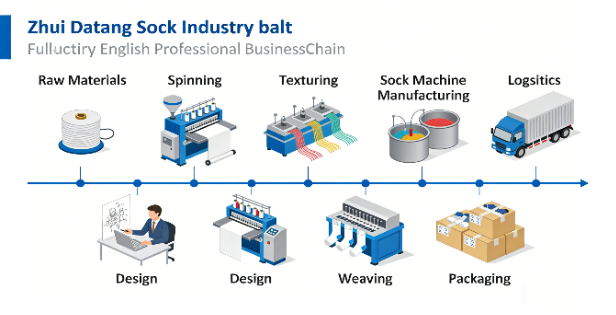
- Industrial Agglomeration Effect: After 40+ years of development, Daxi has formed the world's most complete hosiery supply chain. It covers raw materials, texturing, dyeing, sock machine manufacturing, design, knitting, packaging, and logistics. The local industrial rate exceeds 95%, reducing production costs by 25%-33% compared to other regions.
- Policy Guidance & Platform Building: The government promoted the construction of the Daxi Textile and Garment Trade City and the Hosiery Science Park. Subsidies for intelligent transformation (up to 30%) have guided enterprises toward digitalization and branding.
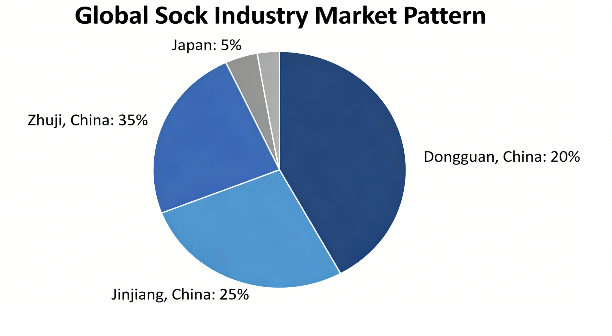
- Current Status of the Hosiery Industry in Zhuji and Globally
- Zhuji Industry Status
- Market Scale: In 2025, the Daxi sub-district produced over 25 billion pairs of socks, accounting for 70% of China's output and 35% of the global total, with an industrial scale exceeding 70 billion RMB.
- Market Entities: It hosts over 14,000 hosiery enterprises, including 208 designated-scale enterprises, and has cultivated well-known brands such as Nai'er, Mengna, and Kaishili.
- Technological Upgrades: The penetration rate of intelligent "knit-sew-turn" machines exceeds 60%. The application of AI visual inspection and 3D design software has reduced labor costs by 40% and shortened order delivery cycles by 10 days.
- Market Channels: Foreign trade accounts for approximately 40% (mainly exported to Europe, America, the Middle East, and Southeast Asia). Domestic sales account for 60%, with e-commerce channels comprising over 50% of this share, growing at 30% annually.
- Global Industry Status
- Market Structure: China is the world's largest producer and exporter of socks, accounting for over 60% of global output. Major production bases include Zhuji (Zhejiang), Dongguan (Guangdong), and Jinjiang (Fujian).
- Consumption Trends: Socks are transitioning from "warmth and utility" to "fashion coordination and functional segmentation." High-value-added products such as sports socks, trendy socks, antibacterial socks, and customized socks are in high demand.
- International Competition: Italy and Japan dominate the high-end brand market (e.g., FALKE,STANCE). China, India, and Vietnam dominate the mid-to-low-end manufacturing sector. However, China is upgrading toward the mid-to-high-end through design and technology.
III. Core Opportunities and Challenges
|
Dimension |
Content |
|
Core Opportunities |
|
|
Main Challenges |
|
- Multi-Dimensional Classification of Socks (Raw Material to Finished Product)
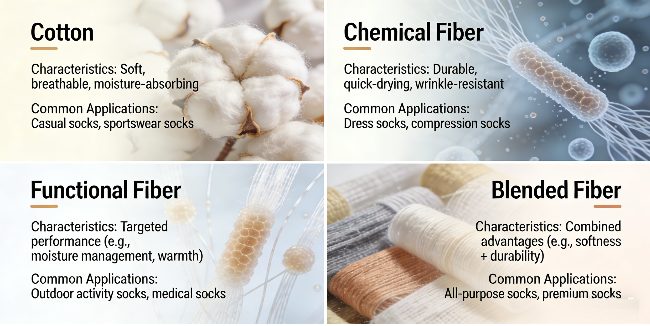
- Classification by Raw Material
|
Type |
Characteristics |
Common Applications |
|
Cotton |
Moisture-absorbing, breathable, soft, cost-effective |
Daily wear, sports socks |
|
Synthetic (Nylon/Polyester) |
Wear-resistant, elastic, quick-drying, low cost |
Sports socks, ankle socks, compression socks |
|
Functional Fibers (Modal/Bamboo/ Silver Fiber) |
Antibacterial, deodorizing, moisture-wicking, anti-static |
Medical socks, antibacterial socks, high-end business socks |
|
Blended |
Combines advantages of multiple fibers for enhanced performance |
High-end trendy socks, professional sports socks |
- Classification by Function & Scenario
- Everyday Socks: Cotton socks, invisible socks, five-toe socks—focusing on comfort and cost-effectiveness.
- Sports Socks: Basketball socks, running socks, mountaineering socks—emphasizing moisture management and support.
- Functional Socks: Antibacterial socks, deodorizing socks, compression socks, acupoint health socks.
- Trendy Socks: IP collaboration socks, designer socks, colorful socks, 3D jacquard socks.
- Professional Custom Socks: Team custom, corporate gifts, wedding socks.
- Classification by Process & Structure
- Standard Socks: Traditional knitting + manual seaming; low cost, high efficiency.
- Seamless Socks: Produced using machines; non-irritating, high fit, and comfort.
- 3D Jacquard Socks: Complex patterns achieved via computer programming; high design value.
- Custom Socks: Support for personalized patterns, sizes, and LOGO embroidery.
- Core Experience in Product Selection & Supply Chain Management
- Product Selection Strategy
- Check Material Composition: High-quality socks typically contain 60%-80% cotton, blended with nylon (20%-30%) to enhance elasticity and wear resistance.
- Inspect Craftsmanship: Check if the seam is flat, the welt (cuff) is tight, and if there is arch support reinforcement.
- Verify Functionality: Antibacterial socks should have SGS test reports; sports socks should have moisture-wicking certifications.
- Assess Design Uniqueness: Prioritize products with IP authorization, original designs, or seasonal best-sellers.
- Supply Chain Selection Experience
- Source Directly: Prioritize designated-scale enterprises or brand factories in Daxi to avoid middlemen markups.
- Evaluate Production Capacity: Check for intelligent machines, AI inspection systems, and ERP management systems.
- Cooperation Models: -- OEM/ODM: Suitable for brand owners; bulk production based on provided designs/samples. -- Drop Shipping: Suitable for e-commerce startups; supports small-batch shipments. -- Joint Development: Collaborate with design factories to co-develop exclusive styles.
- Quality Control: Request third-party inspection reports or verify quality through "sample testing."
- Pitfall Avoidance Guide
- Be wary of "ultra-low-priced" socks, which may use recycled yarn or inferior dyes.
- Avoid cooperating with unlicensed small workshops; recommend transactions via alibaba.com or seenwills.com.
- For export orders, confirm environmental and labor certification requirements to avoid compliance risks.
- Business Travel & Commerce Guide (Daxi Hosiery Trade City)
- Core Commercial Areas
- Daxi Textile and Garment Trade City: Spanning 530,000 sqm with over 3000 wholesalers. It is the world's largest professional sock market. -- Level 1: Sock wholesale area. -- Level 2: Raw materials and accessories market. -- Level 3: Design and brand exhibition area.
- Hosiery Science Park: Aggregates design, testing, training, and e-commerce incubation services.
- East China International Jewelry City: While focused on pearls, some vendors also deal in pearl-themed socks and gifts, suitable for cross-category sourcing.
- Accommodation & Dining
- High-end Hotels: Zhuji Yaoyang Kaiyuan Mingting Hotel, Ji Hotel (Daxi Branch).
- Local Cuisine: Xishi Tofu, Pearl Balls, Cidu Noodles—rich in local flavor.
- Business Support: Multiple co-working spaces, live-streaming bases, and logistics centers are available.
VII. Transportation Convenience Information
- Air
- Hangzhou Xiaoshan International Airport: 60km from Zhuji (1-hour drive), with direct airport shuttle buses.
- Shanghai Hongqiao International Airport: 1.5-hour high-speed rail ride to Zhuji Station.
- High-speed Rail
- Zhuji Station: On the Shanghai-Kunming line. 20 mins from Hangzhou, 1 hour from Shanghai, 40 mins from Ningbo.
- Shaoxing North Station: 30km from Daxi (40-minute drive).
- Highways
- Shanghai-Kunming Expressway (G60): Exit at Zhuji to reach Daxi directly.
- Zhuji-Yongjia Expressway (S26): Connects Hangzhou and Wenzhou, with a Daxi interchange.
- Local Transportation
- Bus: Routes 101 and 102 go directly to the Trade City.
- Ride-hailing: Available throughout the area.
- Parking: Large free parking lots are available at the Trade City.
Conclusion
The Zhuji-Daxi hosiery industry has evolved from the "Sock Capital of the World" to a "Global Hosiery Art Center," achieving high-quality development through digitization, branding, and globalization. For buyers, brand owners, and investors, this is an industrial highland that cannot be missed. Grasping trends, selecting optimal supply chains, and deepening product capabilities are the keys to standing out in this trillion RMB level.
If you want to produce your own brand socks welcome to contact SEENWILLS for help.