Today, we take the 7 primary shipping methods and their freight costs from China to the United States as a service and case study, providing in-depth, professional answers to the core links of international trade you care about from multiple perspectives.
Logistics and shipping are a critical part of importing goods from China to the US. Nowadays, many importers source products through wholesale platforms such as Alibaba, Global Sources, and Made-in-China.
Typically, suppliers arrange shipping for buyers. Experienced importers may choose a trusted freight forwarder and handle shipping independently. However, shipping can be a headache for beginners, especially when comparing different shipping methods and associated costs.
This guide details the 7 major shipping methods from China to the US and their estimated freight costs. After reading, you can easily arrange shipping whether you use the supplier’s designated forwarder or find your own. In short, this is a highly practical resource.
Note: All freight costs listed in this document are pre-pandemic regular prices. The COVID-19 pandemic has had a massive impact on shipping costs, with rates fluctuating extremely frequently—your latest quote today may be invalid in a few days. Additionally, current freight costs are far higher than historical levels (e.g., the price of a shipping container has surged to 7–8 times the normal rate). For actual freight estimates, contact us for real-time quotes.
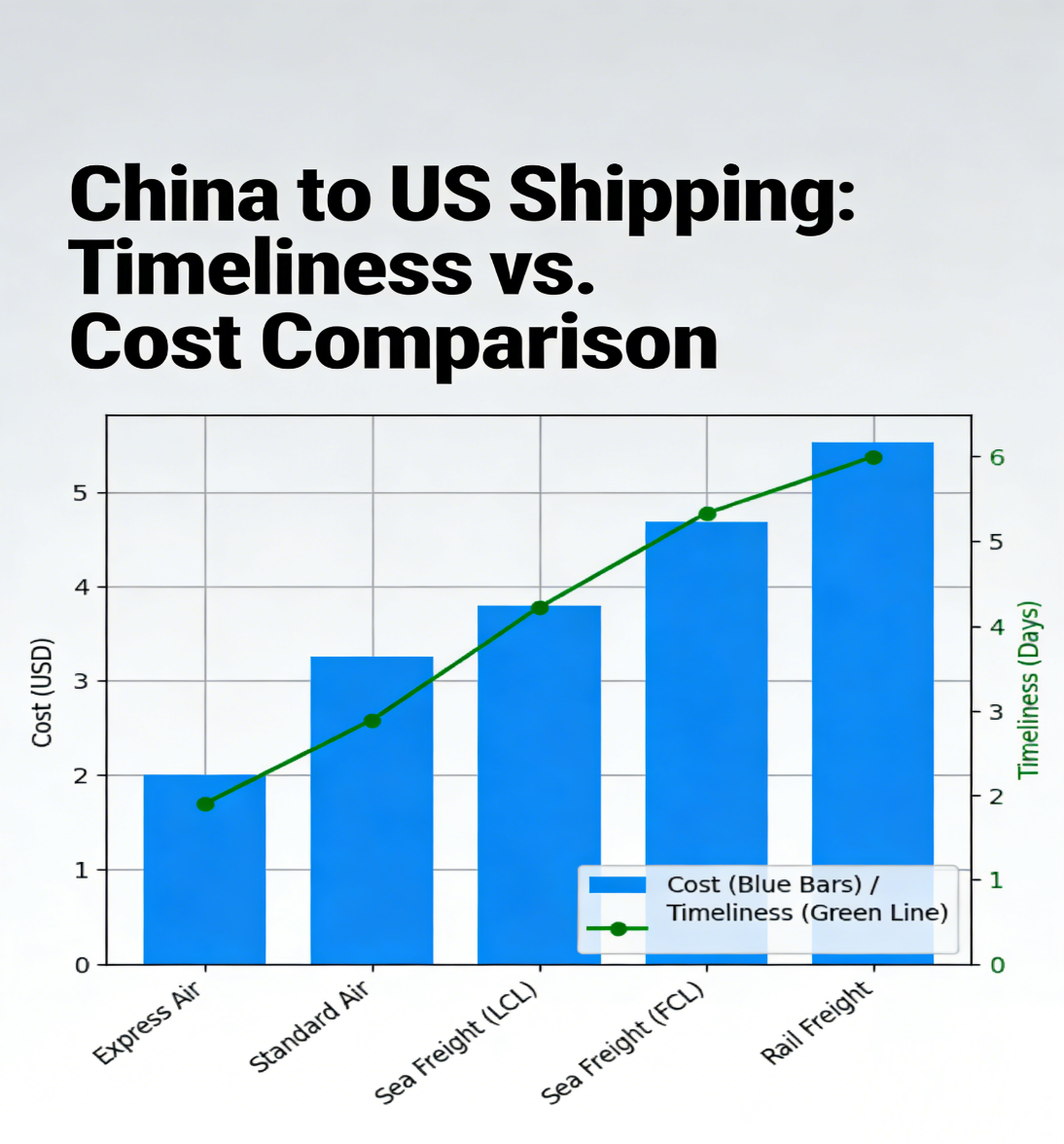
Table of Contents
- Choosing the Optimal Courier Service
- Courier Freight Estimation Method
- Dimensional Weight vs. Actual Weight
- Courier vs. Air Freight
- All-Included Air Freight Cost Calculation
- Detailed Air Freight Breakdown
- LCL vs. FCL in Sea Freight
- All-Included Sea Freight Cost Calculation
- Detailed Sea Freight Breakdown
- Sea Freight + UPS (SFUC)
- Air Freight + UPS (AFUC)
- ePacket for Small Parcels
- China Post for Small Parcels
Note: Incoterms determine your shipping model and directly impact freight costs. If you are unfamiliar with Incoterms, we recommend watching the attached video first.
I. Express Shipping from China to the US
Abundant information about major couriers such as FedEx, UPS, and DHL is available on Google, so this guide will not cover their basic details. Instead, we will directly address two more critical questions:
- When is express shipping the most cost-effective option?
- What types of goods are suitable for express shipping?
Which Courier is the Best?
Compared to sea or air freight, express shipping is the fastest and simplest shipping method from China to the US.
- No need to handle customs clearance procedures
- Freight costs are generally similar for deliveries to the US East and West Coasts
- Simply select a courier with a reasonable quote and wait for delivery
Approximately 95% of small-batch, high-value samples and products are shipped via express. It is also ideal for e-commerce sellers (e.g., Amazon sellers) in urgent need of restocking.
Among FedEx, UPS, and DHL, FedEx and UPS are the most reliable and cost-effective for shipping from China. DHL’s customs clearance process is typically slower than FedEx and UPS, with relatively higher freight costs in some cases.
Express Freight Costs from China to the US
Official quotes from FedEx, UPS, and DHL are usually high, as these couriers offer 20%–50% discounts to agents (your supplier or freight forwarder) based on annual shipping volume, which affects the final price.
If your Chinese supplier does not frequently use FedEx, they can collaborate with a discounted courier agent to ship goods to the US, helping you secure lower freight costs.
In addition to agent discount differences, seasonal factors and remaining flight capacity also impact courier prices (e.g., prices surge in the peak season one month before Christmas and Thanksgiving, and drop significantly in the off-season).
Courier freight costs are therefore extremely volatile—even changing weekly. You need to request real-time quotes from your supplier or forwarder and select the most affordable option.
Get Real-Time Freight Quotes from Seenwills
- Long-term partnerships with top logistics and courier companies for highly competitive pricing
- Professional arrangement of express shipping and cost calculation
- Let Seenwills handle your shipping from China to your country!
FedEx IP vs. IE
While freight costs fluctuate frequently, FedEx prices fall within a certain range. Combined with the reference prices provided and other influencing factors, you can easily estimate the delivery cost to your address.
FedEx offers two international services:
- International Priority (IP): Priority service, delivered in 2–3 business days
- International Economy (IE): Economy service, delivered in 4–6 business days
Table 1: FedEx Freight Rates (21kg+, USD/kg)
| Weight Range | FedEx IP (USD/kg) | FedEx IE (USD/kg) |
|---|---|---|
| 21–70kg | 7 – 7.5 | 6.5 – 6.7 |
| 70kg+ | 6.3 – 7 | 6 – 6.5 |
Note: Prices fluctuated drastically during the pandemic—email us for real-time quotes.
As shown in the table, IP is more expensive than IE. FedEx IP is typically suitable for shipping samples; for goods over 21kg, FedEx IE is recommended.
Important: Goods containing lithium batteries, powders, or liquids cannot be shipped via official FedEx channels. To ship such sensitive goods, they must first be sent to Hong Kong via an agent, then to the US via FedEx or DHL Hong Kong. The freight cost for such goods is usually above USD10/kg.
Dimensional Weight vs. Actual Weight
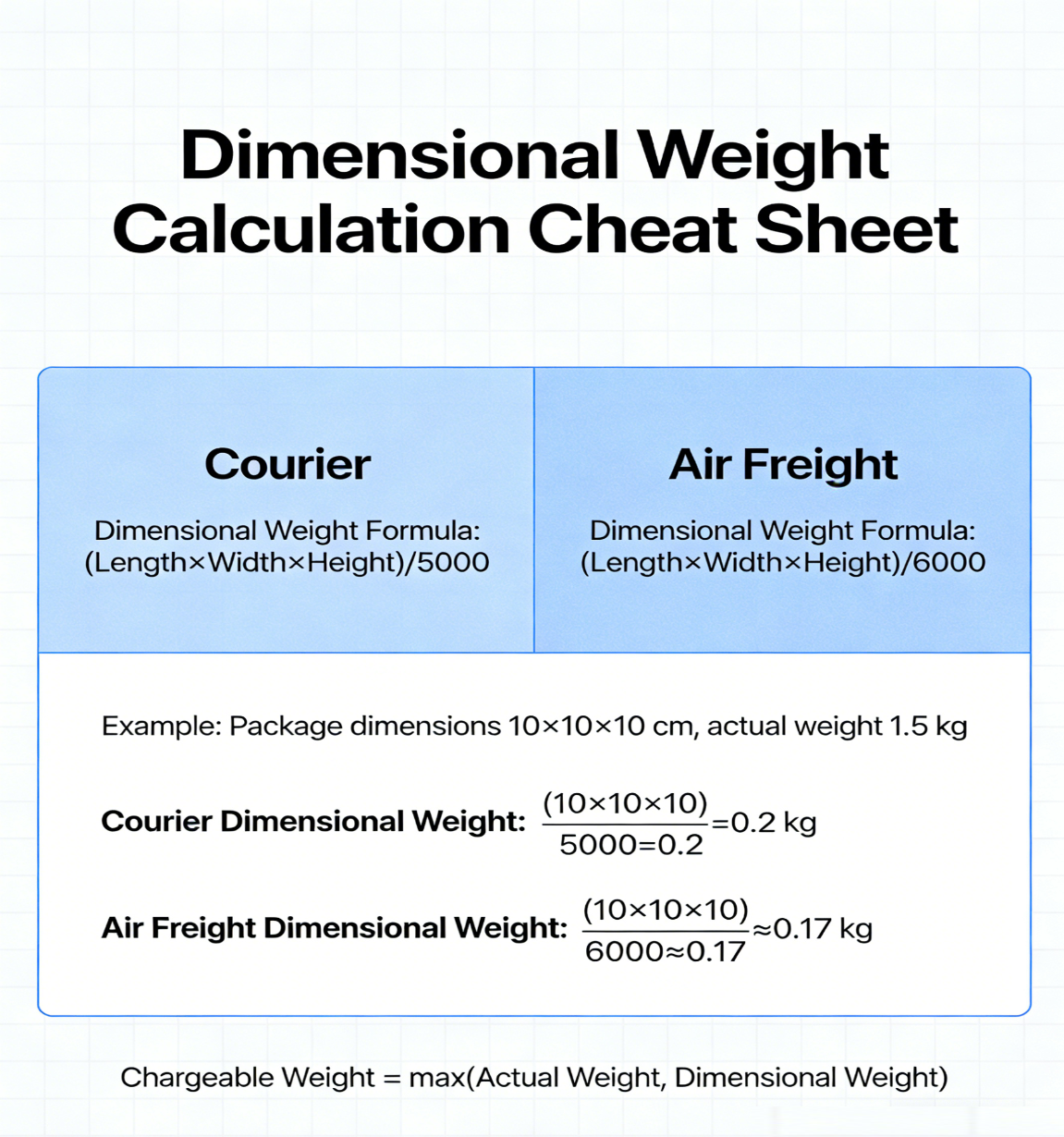
Couriers charge based on chargeable weight, which is the greater of the actual weight and dimensional weight.
Dimensional Weight Formula:
Length (cm) × Width (cm) × Height (cm) ÷ 5000
Example: A foam box with dimensions 100×100×100cm and actual weight 20kg
Dimensional weight = 1,000,000 ÷ 5000 = 200kg → Charged at 200kg!
Customs Clearance Tip
FedEx exempts tariffs for goods valued below USD800. For goods exceeding USD800, the courier will advance the tariff, and you will pay it upon delivery.
Key Recommendation: If your supplier ships via FedEx on your behalf, it is best to pay the freight in advance to the supplier. Even if you have a FedEx account in the US, do not choose collect on delivery (COD), as the fees will be extremely high.
II. Air Freight from China to the US
Both express and air freight use aircraft, but there are distinct differences between the two modes.
Key Differences: Courier vs. Air Freight
| Aspect | Courier Shipping | Air Freight |
|---|---|---|
| Service Mode | Door-to-door, fully streamlined | Airport-to-airport (plus optional delivery) |
| Ideal Cargo Weight | <500kg | >500kg (more cost-effective) |
| Cost Efficiency | High for small batches | High for medium/large batches |
| Customs Clearance | Handled by the courier | Handled by freight forwarder/importer |
Cost Threshold Tip:
500kg: Air freight is more cost-effective
300–500kg: Real-time price comparison is required (courier may be cheaper if flight capacity is sufficient)
All-Included Air Freight Cost
Always confirm with your freight forwarder or supplier whether the quote is all-inclusive—i.e., covers all costs from the Chinese airport to your doorstep.
⚠️ Warning: Be cautious of suppliers who only quote an airport-to-airport price! Such quotes seem low but exclude US customs clearance fees and local delivery fees, which will be charged as additional costs.
Reference All-Included Air Freight Rates (>500kg):
- Air freight: ~USD5.5/kg
- Courier shipping: ~USD6.5/kg
Note: This price does not include inland freight from the Chinese factory to the airport.
Air Freight Timeliness
Total transit time = Booking time + Flight time + US local delivery ≈ 4–7 days
Air Freight Pricing Rules
- Dimensional Weight Formula: Length × Width × Height ÷ 6000 (different from courier’s ÷5000)
- Chargeable weight is still the greater of actual weight and dimensional weight
Freight Composition Under FOB vs. EXW Incoterms
FOB (Free On Board)
- Supplier’s responsibility: Factory → Chinese airport + Chinese export fees
- Importer’s responsibility: Chinese airport → US airport; US customs clearance + local delivery
EXW (Ex Works)
- Supplier’s responsibility: Only production of goods
- Importer’s responsibility: All shipping links (Chinese factory → Chinese airport → US airport → your doorstep)
As a leading sourcing company in China, we offer one-stop sourcing, shipping, and freight cost calculation services for your convenience.
III. Sea Freight from China to the US
Sea freight is recommended if your cargo volume exceeds 2 cubic meters (CBM), as it is the most cost-effective option for large-batch, low-weight-to-volume goods.
LCL (Less Than Container Load) vs. FCL (Full Container Load)
Table 2: LCL vs. FCL Comparison
| Aspect | LCL (Less Than Container Load) | FCL (Full Container Load) |
|---|---|---|
| Applicable Cargo | Small volume (<15–20 CBM) | Large volume (>15–20 CBM) |
| Pricing Unit | Per CBM/kg (whichever is higher) | Per container (fixed rate) |
| Cost Efficiency | Low for small batches | High for large batches |
| Transit Time | Slightly longer (consolidation required) | Faster (direct shipping) |
| Loading/Unloading | Shared container with other shippers | Exclusive use of container |
All-Included Sea Freight Cost & Timeliness
Sea freight costs vary significantly by container type (20ft/40ft/40HQ) and US port (East/West Coast). The following are pre-pandemic reference all-inclusive rates (covering port fees, customs clearance, and local delivery):
Table 3: Sea Freight Reference Rates & Timeliness
| Container Type | US West Coast (USD) | US East Coast (USD) | Transit Time (Days) |
|---|---|---|---|
| 20ft | 1,200 – 1,500 | 2,000 – 2,500 | 18–22 |
| 40ft | 2,000 – 2,500 | 3,500 – 4,000 | 25–30 |
| 40HQ | 2,200 – 2,800 | 3,800 – 4,500 | 25–30 |
Note: Current pandemic-era rates are 7–8 times higher—contact us for real-time container quotes.
Sea Freight Cost Breakdown (All-Inclusive)
- Origin fees: Factory to Chinese port inland freight, port handling fee, export customs declaration fee
- Ocean freight: Carrier’s charge for port-to-port shipping
- Destination fees: US port handling fee, customs clearance fee, duty/tax, local delivery fee to doorstep
IV. Combined Shipping Modes: SFUC & AFUC
For e-commerce sellers and importers seeking a balance of cost and timeliness, combined shipping modes (sea/air freight + UPS delivery) are ideal alternatives to pure express or sea/air freight.
1. SFUC (Sea Freight + UPS)
- Process: Sea freight to US port → UPS ground delivery to doorstep
- Timeliness: 25–35 days (faster than pure sea freight, cheaper than pure express)
- Ideal for: Non-urgent large-batch e-commerce goods (e.g., Amazon FBA replenishment)
-
- US West Coast: ~USD1.5/kg
- US Midwest: ~USD1.6/kg
- US East Coast: ~USD1.8/kgReference All-Included Rates (>500kg):
Surcharge Note: High-duty goods (e.g., textiles, hardware) may incur an additional USD0.3–0.4/kg.
2. AFUC (Air Freight + UPS)
- Process: Air freight to US airport → UPS express delivery to doorstep
- Timeliness: 11–15 days (slower than pure express, much faster than sea freight)
- Ideal for: E-commerce sellers with urgent restocking needs
- Reference All-Included Rates (>500kg):
- US West Coast: ~USD3.9/kg
- US East Coast: ~USD4.3/kg
V. Small Parcel Special Lines: ePacket & China Post
For small, low-value parcels (<2kg), ePacket and China Post are the most economical shipping options, specifically designed for cross-border small parcel delivery.
ePacket (Ideal for <2kg Small Parcels)
Core Specifications & Rates:
- Starting price: USD2.17/parcel
- Additional weight fee: USD0.009/gram (minimum charge for 50g)
- Weight limit: 2000g
- Size limit: Length + Width + Height <90cm, maximum side ≤60cm
- Timeliness: 8–14 days (potential delays of 1–2 months during peak seasons)
- Liability: No price insurance, no compensation for delays
- Prohibited goods: Liquids, powders, flammables/explosives, alcohol, tobacco, infringing goods, etc.
Pricing Example: Freight for a 120g lipstick = 2.17 + (120×0.009) = USD3.25
China Post Small Parcel
- Cost: Cheaper than ePacket, but slower
- Timeliness: Sea freight (1–2 months), air freight (15+ days)
- Liability: No compensation guarantee for loss/delay
- Weight limit: 30kg
- Ideal for: Low-value, non-urgent goods (e.g., 100 carbon pens)
Conclusion
We hope this guide helps you:
- Understand the 7 mainstream shipping methods from China to the US
- Master freight cost estimation methods
- Select the optimal shipping solution based on your cargo characteristics
If you still have questions, feel free to leave a message or contact us for real-time freight quotes. We offer:
- One-stop sourcing and logistics services
- The most competitive freight rates in the market
- Stable shipping guarantees even during market fluctuations
Let us help you ship goods from China to the world with ease!
Core Eye-Catching Visuals (3 Key Infographics)
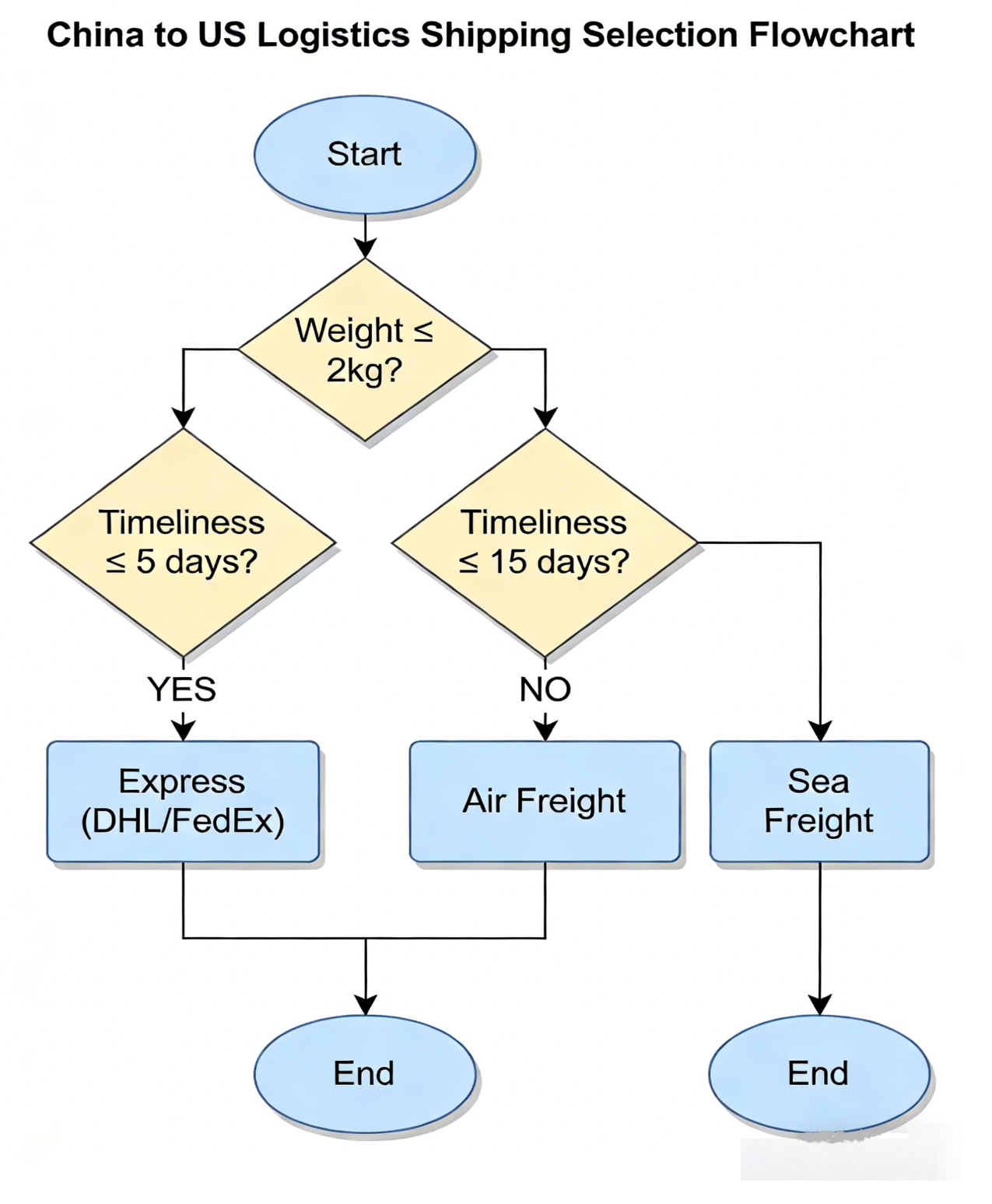
Infographic 1: Shipping Mode Selection Flowchart (China → US)
Core Logic: Cargo Weight/Volume → Urgency → Optimal Shipping Method
- <2kg, low-value: ePacket/China Post
- 2kg–500kg, urgent: FedEx/UPS IP
- 2kg–500kg, non-urgent: FedEx/UPS IE
- 300–500kg: Compare courier/air freight real-time prices
- 500kg, urgent: Air Freight/UPS (AFUC)
-
500kg, non-urgent: Sea Freight/UPS (SFUC)
-
2CBM: LCL/FCL sea freight (most cost-effective)
Infographic 2: Chargeable Weight Calculation Cheat Sheet
Side-by-Side Comparison:
- Courier Shipping: L×W×H (cm) ÷ 5000
- Air Freight: L×W×H (cm) ÷ 6000
- Visual Example: 100×100×100cm box → Courier (200kg) vs. Air Freight (166.67kg)
- Key Reminder: Always use the greater of actual/dimensional weight
Infographic 3: China → US Shipping Timeliness & Cost Comparison (Snapshot)
5 Core Modes Visualized with Bar/Line Charts:
| Shipping Mode | Avg. Timeliness (Days) | Avg. Cost (USD/kg, >500kg) |
|---|---|---|
| FedEx IP | 2–3 | 7–7.5 |
| Air Freight | 4–7 | 5.5 |
| AFUC | 11–15 | 3.9–4.3 |
| SFUC | 25–35 | 1.5–1.8 |
| FCL Sea Freight | 18–30 | ~0.5–1 (per kg, 40HQ) |
If you are in a need of Shipping Service please feel free to let SEENWILLS know.