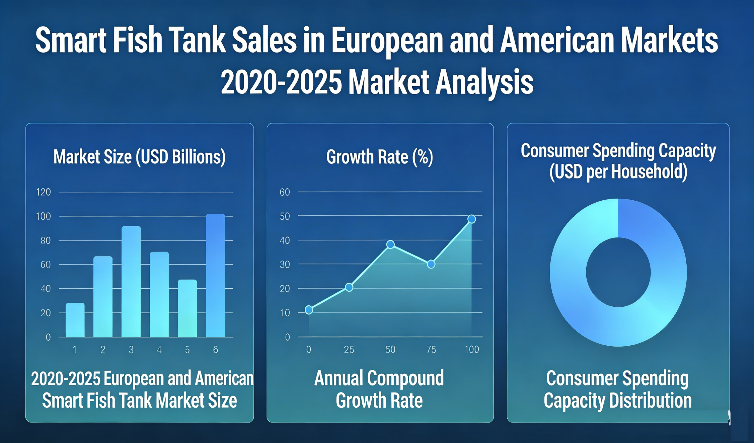
The smart aquarium industry is experiencing rapid growth, with the market scale increasing from less than 2 billion RMB in 2020 to approximately 6.8 billion RMB in 2025, maintaining a steady compound annual growth rate (CAGR) of over 7%. Notably, smart aquatics equipment has emerged as the core engine of this expansion, with shipment volumes surging by 136% year-on-year. Projections indicate that by 2030, the penetration rate of smart aquariums within the overall aquatics equipment market will rise from less than 12% in 2025 to over 35%, potentially reaching a market size of 850 million RMB.
1. Market Performance in North America and Europe
The North American and European markets serve as the "high-end stronghold" for smart aquariums, capturing nearly 70% of the global market share with robust growth momentum.
- Market Scale and Growth: In 2024, smart aquatics equipment accounted for 35% of the global market share, with a year-on-year growth rate exceeding 28%, significantly outpacing the 8.5% growth of basic models. North America alone contributes approximately 40% of the global share, making it the largest single market.
- Spending Power: In the United States, 13% of households keep aquatic pets, comprising around 18 million families who spend an average of $228 annually—an increase of 12% year-on-year. Consumers are willing to pay a 30%-50% premium for "convenience-oriented" features.
- Pricing and Demographics: The core price range in Western markets is $50–300, primarily targeting middle-class families and young pet owners in North America and Europe.
2. Competitive Landscape Analysis
The competitive landscape in Western markets reflects a dichotomy: foreign giants dominate the high-end sector, while Chinese brands are aggressively capturing the mid-range segment.
- Western Industry Leaders (High-End Segment):
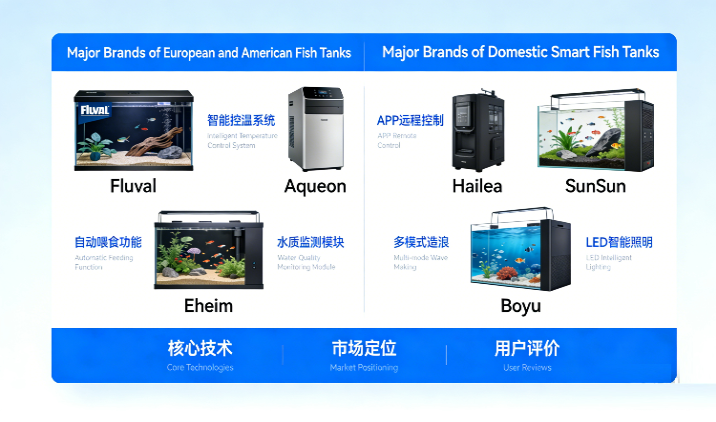
- Marineland (USA): The market leader in North America, offering a comprehensive product line from entry-level to professional-grade tanks, with absolute dominance in large aquariums.
- Fluval (Canada): A subsidiary of the Hagen Group, renowned for high-performance filtration systems and ecological simulation technology, favored by professional enthusiasts.
- EHEIM (Germany): Known as the "Mercedes-Benz of the aquatics industry," it commands the high-end market with precision engineering and ultra-quiet filtration systems.
- Tetra (USA): The world's largest aquatics brand, with extensive product lines and high penetration in pet supermarket chains like PetSmart.
3. Selection Criteria and Consumer Preferences
Consumer demands in Western markets differ significantly from those in China. Product selection must emphasize "technological integration" and "ecological simulation."
- Technology-Driven (North America): U.S. consumers prioritize integrated water quality monitoring. Approximately 61% of mid-to-high-end users are willing to pay a premium for Wi-Fi connectivity, real-time pH monitoring, and automated feeding systems.
- Ecological Simulation (Europe/Germany): German consumers value "ecosystem balance management" as the core joy of fishkeeping. They prefer modular designs, detachable filtration systems, and open-top structures for easy maintenance.
- Design Trends: Western markets favor rectangular glass tanks. Key product categories include metal halide or coral lighting and high-efficiency filtration units.
4. Domestic Brand Landscape
The Chinese market is characterized by a "dual-power" structure, pitting "tech newcomers" against "traditional manufacturing giants."
- Tech Newcomers (Cross-Industry Brands): Led by Xiaomi, DBG (Dangbei), and Hua Fa Ji He, these brands leverage expertise in smart hardware to promote "AI stewardship" and "whole-home smart integration." With minimalist designs, they appeal to young consumers. For instance, the DBG Smart Aquarium 1 Ultra has gained prominence in the high-end market with its dual-filtration system and AI smart-care technology.
- Traditional Giants (Manufacturing Veterans): Brands like Sensen, Boyu, Minjiang, and Jebo possess deep manufacturing roots and offline channels, dominating the professional and large-tank segments with comprehensive product lines.
5. Sales Channels and E-commerce Dynamics
Sales are highly dependent on online channels, with e-commerce accounting for over 61.3% of total sales in 2024—a figure expected to surpass 70% by 2027.
- Key Platforms: JD.com (dominant in 3C electronics), Tmall (brand flagship stores), and Douyin (fastest-growing, with an 89.4% growth rate).
- Marketing Models: Short-video "seeding," live-streaming e-commerce, and scenario-based content marketing (e.g., showcasing aquariums as home décor) are primary customer-acquisition tools.
6. Leading Manufacturers and Supply Chains
- Sensen Group: Based in Zhoushan, Zhejiang, it is China's leading enterprise in aquatics equipment, producing everything from tanks to water pumps and fish food, with exports to dozens of countries.
- Boyu Group: Located in Zhongshan, Guangdong, it is a pioneer in international aquatics and garden machinery, formulating national standards and exporting to over 80 countries.
- Jebo (JEBO): A "hidden champion" from Guangdong, exporting to 73 countries, with its mini desktop tanks frequently topping best-seller lists on Douyin.
- Xiaomi Ecosystem/DBG: These typically rely on OEMs or ecosystem partnerships, leveraging the robust supply chains in the Pearl River Delta, with core advantages in software development and smart-ecosystem integration.
* If you want to know more about the great China brand fish tank please let SEENWILLS know.
7. Core Functionalities: From Automation to AI Stewardship
Smart aquariums have evolved from simple automated feeders to comprehensive "hands-off" solutions.
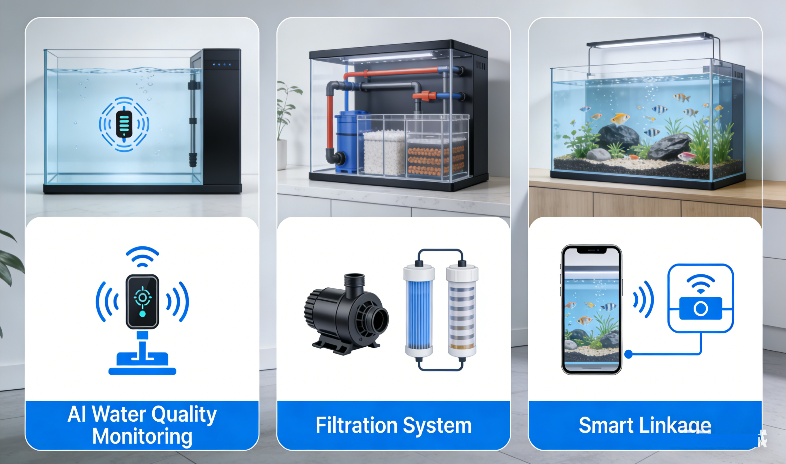
- AI Water Quality Monitoring and Management: Sensors monitor water temperature, pH, and ammonia levels in real-time. Mobile apps provide automatic alerts and solutions, adjusting feeding amounts and lighting modes based on fish behavior.
- High-Efficiency Filtration Systems: Utilizing back-filtering and drip-box technologies, these systems cover physical, biochemical, and chemical filtration, significantly extending water-change cycles (some products require no changes for months).
- Whole-Home Smart Integration: Compatibility with smart-home systems like Xiaomi's Mi Home or Huawei's HarmonyOS allows voice-controlled feeding and lighting, as well as联动 (interconnection) with other appliances.
- Aesthetic Design: Featuring ultra-clear glass and minimalist aesthetics, combined with full-spectrum ecological lighting, the aquarium is elevated from a utility to a home décor statement.
8. Global Market Performance and Export Dynamics
- Market Share: China produces 42% of the world's smart aquariums, making it the largest global manufacturing base.
- Regional Trends: The global smart aquatics equipment market has grown from 18% in 2021 to 35% in 2025, with a CAGR of 28%, far exceeding the 8.5% growth of basic models.
- Consumer Demographics: The primary consumers for smart models in North America and Europe are middle-class families, with price points concentrated between $50 and $300. In contrast, the Southeast Asian market favors high-value, basic models.
9. Strategic Considerations for Cross-Border E-commerce
Entering the international market requires attention to several critical details.
- Regulatory Compliance: Ensure adherence to electrical safety standards (e.g., UL in the U.S., CE in Europe) and material regulations (e.g., RoHS).
- Localization Strategy: Adapt product manuals, app interfaces, and customer support to local languages. Marketing should emphasize "ecosystem management" in Europe and "smart technology" in North America.
- Logistics and After-Sales: Given the fragility of glass components, robust packaging solutions are essential. Establishing local warehousing or partnerships can improve after-sales service and reduce return logistics costs.
- Brand Positioning: Avoid price wars by focusing on technological differentiation (e.g., superior filtration, AI monitoring) to justify premium pricing in Western markets.